
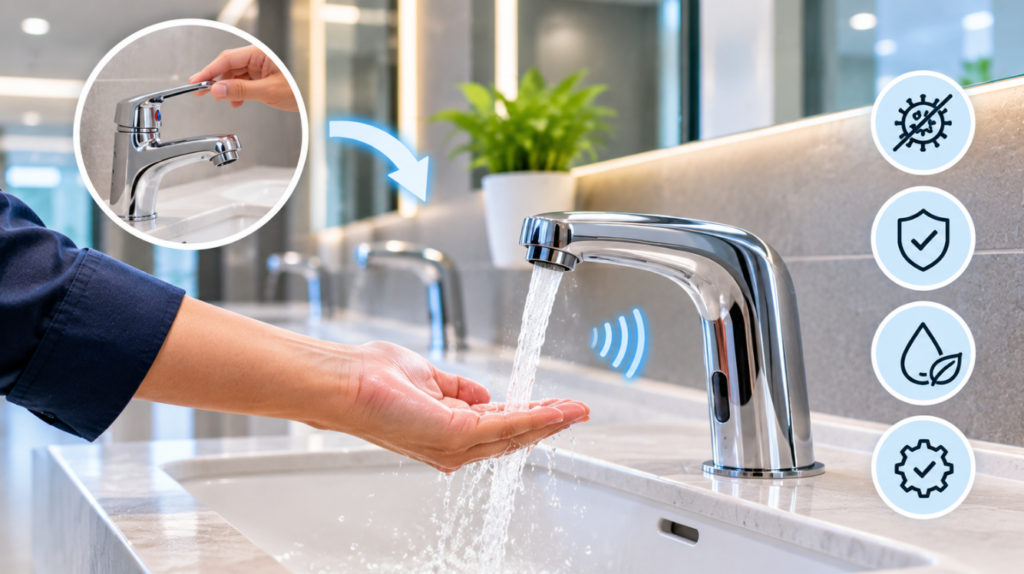
Think about running an office, a hotel, a hospital, or a shopping center where hundreds of people use washrooms daily. Maintaining hygiene levels, saving on water consumption, and maintaining all facilities becomes increasingly difficult. And while traditional faucets may seem insignificant, they may still impact your hygiene maintenance and operational costs.
Touchless bathroom faucets can help you with these challenges. Providing the ability to turn on a faucet without contacting the handle, such a fixture can be a convenient solution for increasing washroom convenience and minimizing water usage.
For a facility manager, installing touchless faucets is more than implementing a piece of technology. This is a matter of using efficient and cost-effective solutions to increase hygiene levels, reduce consumption, and save money.
In this blog, we will look into the advantages of using touchless faucets, factors to take into account before purchasing and installing the fittings, as well as the role of Nova Tech in choosing commercial washroom fittings.
Table of Contents
ToggleWhat Are Touchless Bathroom Faucets?
A hands-free bathroom faucet works through the use of sensors that detect the presence of a person’s hand in order to control the water flow.
Contrary to regular faucets, these types of fittings are not handled manually. These are therefore very suitable for places that experience heavy traffic since the aspect of ease of use, sanitation, and management of water is crucial.
A sensor activated touchless bathroom sink faucet normally works through the use of either infrared or other sensors that detect motion within a certain distance from the faucet. If you want to understand how a sensor tap works, the method of powering the faucet and triggering the solenoid valve can vary depending on the type.
For facility administrators, the chief benefit is the ability to minimize any unnecessary contacts while maintaining water flow in a regulated manner.
- Improve Hygiene in High-Traffic Washrooms
These taps are constantly being used by different individuals through the day. On commercial premises, there is the need to increase the number of surfaces that need frequent cleaning.
The touchless faucets have been very effective in hospitals, clinics, hotels, restaurants, office buildings, and other public facilities where many people share the same washroom, much like other commercial bathroom fixtures for high-traffic buildings.
The touchless faucets have been very effective in hospitals, clinics, hotels, restaurants, office buildings, and other public facilities where many people share the same washroom.
- Minimize Water Wastage
Management of water is a very significant concern in buildings that have a number of washrooms. Traditional faucets can still be left open when people are doing other things, like putting soap on.
Touchless faucets will reduce this problem because of their capability of controlling water supply depending on their sensor settings and design. The water will flow when the hands are detected, and it stops once the hands are taken away.
- Make Washrooms Easier to Use
The washroom should be accessible for all, including seniors, individuals with limited hand movements, and guests that might face difficulties operating the regular handles.
Touchless faucets eliminate the need to turn or press a handle, thus providing easy access to water for most people. It can make things easier in hotels, medical centers, malls, offices, and other spaces designed around commercial restroom design standards.
- Make Cleaning Easy
Regular handles get fingerprints and water stains on them, which need to be cleaned regularly by the facility maintenance crew due to high usage.
A touchless faucet eliminates the need for such actions but requires cleaning the spout and other exposed parts.
While choosing the model to purchase, one needs to pay attention to the material, corrosion resistance, and replaceable parts as well as accessibility of the sensors and interior mechanisms.
- Consider Touchless Faucets Beyond the Bathroom
A touchless kitchen faucet enables the user to turn on the water without turning on a traditional knob.
If one is considering the installation of a touchless faucet kitchen sink, he or she should consider the height of the spout, its reach, the size of the basin, the water pressure, and the sensitivity of sensors.
In case of limited space, comparing different types of taps shows that a touchless sink faucet for the kitchen can be a good choice, depending on the particular model.
- Select the Appropriate Touchless Kitchen Sink Faucet
Not all touchless faucets can be used in any circumstances. The touchless faucet meant for a private kitchen cannot be used in a commercial kitchen where it is going to be operated more intensively.
When comparing touchless faucets for kitchen sinks, facility managers should evaluate the durability of the models, ease of cleaning, water flow, power source, and ease of repair.
Also, touchless kitchen sink faucets installed in the kitchens of employees or hospitality establishments should be chosen depending on the usage and basin size.
Before making a decision, consider:
- Reliability of the sensor: The faucet must be reliable and not trigger unnecessarily.
- Flow of water: Flow must fit the purpose but be water-efficient.
- Design: Design must hold up to constant usage and cleaning.
- Installation: Must be sure to match the existing sink, plumbing, and electrical needs.
- Serviceability: Look for easy access to parts such as the batteries, valves, and sensor.
These considerations will ensure that the chosen product fits the space needs, as opposed to just the aesthetics.
- Evaluate Installation Costs and Long-Term Value
There is a start-up cost involved when replacing manual faucets with touchless models. Installation of certain touchless models may include setting up connections, batteries, plumbing, and modification of the existing basin.
Facility managers need to take into account the total cost but not just the cost of the product alone.
This includes the cost of purchasing, installation, the volume of water expected to be used, maintenance, spare parts, and the expected lifespan of the product.
- What Should Facility Managers Check Prior To Upgrading?
A successful switch starts with assessing the needs of the building.
In considering the touchless sensor faucet, facility managers must ask themselves the following questions:
- Rate of usage: How many people use the washrooms and kitchens every day?
- Sensor quality: Detection distance and speed of response as well as the functionality of the automatic shut-off feature.
- Water efficiency: The rate of flow and water-saving features.
- Usability: Facility managers must ensure that the product is user-friendly.
- Compatibility: Does the product fit the plumbing and power supply system?
- Warranty and service: Is the warranty offered, and is there service after sales?
Facility managers need to inspect the existing faucets before they replace them.
How Nova Tech Fits into Touchless Faucet Selection
Choosing bathroom fittings involves a combination of convenience, efficiency, maintenance, and affordability. Facility managers who are responsible for several locations can benefit from standardization of bathroom fittings that fit their requirements.
Nova Tech should be taken into account when assessing various bathroom and washroom fittings for commercial applications, including smart washroom automation solutions. Customers need to check what is offered in terms of product specifications, sensor features, installation conditions, and warranties.
When considering purchasing either a touchless bathroom faucet for the public washroom or other touchless fitting for a staff kitchen, the first step should be choosing the appropriate product for its particular application.
The well-defined specification allows procurement managers to make comparisons and purchase products based not only on the looks but on their performance characteristics as well.
Conclusion
Touchless faucets could assist in enhancing washroom convenience and reducing the risk of coming into contact with any shared handle while conserving the usage of water at the same time. However, the efficiency of such faucets relies greatly on choosing proper products, installation process, and maintenance of these faucets.
Before you go ahead and replace your current faucets, you should consider the usage levels in your facility, plumbing needs, sensors’ performance, and cost of operation.
Through proper planning and evaluation of various products, it would be reasonable to contact Nova Tech as one of your options during the commercial washroom procurement process.
Frequently Asked Questions
- How does a touchless faucet for bathrooms function?
It utilizes sensors to detect the presence of a user’s hands, and then it activates the water supply. It turns off the water once hands move away depending on the operation mode.
- Do touchless faucets save water?
Yes, they can reduce the unnecessary water supply due to automatic activation and deactivation. The water savings vary based on several factors.
- Can touchless faucets be installed in commercial kitchens?
Yes, appropriate touchless faucets can be installed in commercial kitchens as well. Buyers must check the durability, sensor performance, cleaning requirements, etc.
- What is the required maintenance for touchless sensor faucets?
Touchless faucets may need maintenance, such as cleaning the sensor and the spout, changing batteries (if present), checking water flow, servicing valves and more.
- What should facility managers consider before purchasing touchless faucets?
Facility managers should consider the sensor performance, water efficiency, installation compatibility, accessibility, maintenance cost, and expected daily use.
How useful was this post?
Click on a star to rate it!
Average rating 0 / 5. Vote count: 0
No votes so far! Be the first to rate this post.