
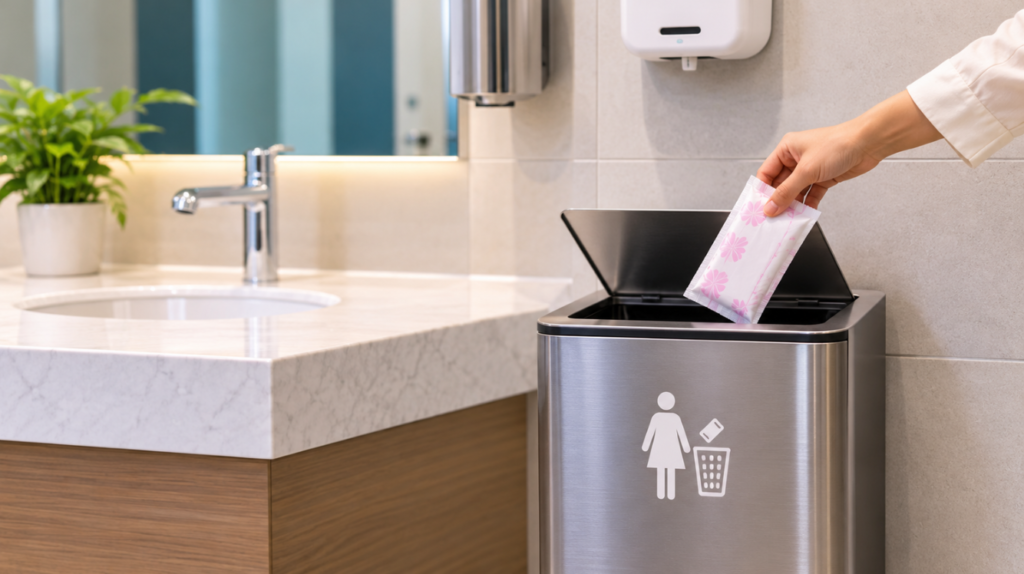
The cleanliness of the floors, functional water sources, and good smell are not the only elements of a properly functioning commercial washroom. Sometimes even minor details like the provision of appropriate equipment for disposing of feminine waste should be considered as essential elements of the washroom.
Let us suppose that a woman enters a commercial washroom in an office, hotel, shopping mall, or educational institution and does not see a suitable location for disposing of her used sanitary pad. It can cause embarrassment and discomfort and, as a consequence, lead to improper waste disposal.
For managers of facilities, selection of the right sanitary napkin disposal bin will be a necessary part of their plans. Proper products make the process easier, improve hygiene, and facilitate waste management for the cleaning personnel.
Here are the factors that need to be taken into account while selecting a product.
Table of Contents
ToggleWhy Does Every Commercial Washroom Need a Sanitary Disposal Bin?
The right disposal facilities need to be there for menstrual waste products. Users would use the toilet bowl, general bins, or any other place to dispose of their used sanitary napkins because there is no specific bin. It leads to blocked toilets and the smell of sanitary pads, which makes cleaning difficult.
Putting up a proper sanitary napkin dustbin makes it easier and more convenient for users to dispose of sanitary napkins safely and hygienically.
Sanitary napkin dustbins have become necessary in all places like offices, hotels, shopping malls, hospitals, schools, colleges, and many more public places.
For the managers of facilities, making sure the right disposal arrangement is there shows care about their daily needs and supports public sanitation in clean facilities.
You Must Choose the Right Type of Sanitary Disposal Bin
However, not all washroom facilities have identical design specifications and usage requirements. The disposal bin that you choose will be contingent upon the space that you have and your installation preferences.
- Wall-mounted Sanitary Bins
For commercial washroom facilities that lack enough room on the floor, wall-mounted sanitary bins will be ideal. They can be mounted at a comfortable height so that the floor becomes easy to clean and that the receptacles do not occupy space in the areas of movement.
- Floor Standing Sanitary Bins
In addition to wall-mounted units, floor-standing disposal bins are also available. They can be placed in any convenient place, for instance, next to toilets, without the need to mount them on the wall.
- Hands-free Disposal Bins
Hand-free sanitary bins will give you an opportunity to dispose of waste products without using the lid or a handle. Depending on the mechanism of action, the hands-free disposal bin may utilize either a pedal or a sensor.
Consider Capacity and Expected Footfall
One of the most important considerations while buying a sanitary pad dustbin is its capacity.
A small-sized one will suit the needs of a private office washroom that does not get heavy traffic throughout the day. But the same type might need to be emptied often in places such as shopping malls, airports, hospitals, and other large office buildings.
Some factors you need to keep in mind before opting for a particular size are:
- Number of people visiting the washroom everyday.
- Number of female washrooms.
- Volume of sanitary waste produced.
- Waste collection frequency.
- Available space for installing the dustbin.
Getting a proper-sized sanitary pad disposal bin will help the cleaning team deal with the waste without any interruptions.
But just because of increased capacity, there should be no delay in disposing of the waste.
Prioritise Hygiene and Odour Control
Sanitary waste products must be disposed of safely. This is because waste left out or bins not cleaned on a regular basis could result in foul smells.
While assessing a sanitary napkin disposal bin, consider aspects that promote public bathroom hygiene and proper waste storage.
An ideal lid can facilitate the concealment of waste products, whereas a proper opening can ensure the ease of disposal without any contact.
Also, some sanitary napkin disposal bins have the option of removing the inner container.
Does an Antibacterial Finish Make a Difference?
Antibacterial washroom products can also be found on the market that are covered by an antibacterial coating.
An antibacterial sanitary napkin disposal bin might come in handy as an additional element in case the importance of hygiene is high at a place where many people use it every day.
Yet, before purchasing such products, facility managers need to learn more about their antibacterial feature.
Look for information on whether the producer gives any data regarding the coating used, its characteristics, and its durability under routine cleaning.
Moreover, one should not regard an antibacterial surface as an alternative to cleaning, waste disposal, and proper handling.
Select Durable and Easy-to-Clean Materials
Because of the high level of use and constant exposure to cleaning chemicals, a disposal bin needs to be made from materials that will be able to withstand such conditions.
Stainless steel waste receptacles and robust plastic bins are two popular choices:
- Stainless steel: This material is appreciated due to its robustness and corrosion-resistant properties. Moreover, it can add to the aesthetics of modern commercial washrooms.
- Plastic bin: Plastic bins are usually light and have various design options. They may serve as an appropriate solution for facilities that need simple disposal bins.
In terms of comparing products, you need to pay attention to the quality of a lid, hinges, mechanism of the lid opening, and inner box. All these parts are subjected to intensive usage and should have appropriate strength to withstand this environment.
Choosing a reliable sanitary napkin bin can help save on maintenance costs.
Look for Convenient and Discreet Disposal Features
The disposal bin must create a feeling of comfort among the users. It must allow discreet disposal of waste without exposing it to the user or creating any inconvenience.
Some considerations for its design include:
- A covered opening so that waste cannot be seen.
- An appropriately sized opening to facilitate easy disposal of waste.
- A removable inner container to enable cleaning.
- A lid that will prevent any smell from escaping.
- Foot-activated or touch-free system where necessary.
Its positioning is as critical. It must be within easy reach of the toilet cubicle without interfering with the movement of the user.
In the case of big buildings, placing a disposal system in every female washroom cubicle might be more convenient than placing it outside the cubicles.
Consider Maintenance and Waste Management
Even a quality disposal bin requires maintenance. Lack of maintenance can result in overflowing waste, foul odors, and unclean washroom hygiene.
It is important for facility managers to set up a procedure for collecting and cleaning of waste.
This process should be:
- Conducting checks of the bins on capacity and cleanliness.
- Disposal of waste in accordance with the frequency of use.
- Cleaning and disinfecting with appropriate products.
- Replacement of liners when necessary.
- Proper handling and disposal of collected sanitary waste according to relevant regulations.
Good maintenance will help housekeeping teams detect any broken lids and loose parts in the equipment beforehand.
The purpose of the maintenance is not only to put the disposal unit in place but also to keep it clean and usable at all times.
Conclusion
The selection of an appropriate sanitary disposal bin is an integral aspect of designing a clean washroom alongside other commercial washroom fittings. Factors like capacity, materials, installation, odor control, and maintenance should be considered when making the decision.
Facility managers should make sure that their selection allows users to dispose of their items easily while housekeeping staff are able to keep them clean.
You can contact Nova Tech to explore suitable options based on your facility’s evaluation and waste management process.
Frequently Asked Questions
- What is a sanitary napkin disposal bin?
Sanitary napkin disposal bins refer to a special receptacle that is specifically designed for collecting used sanitary pads and other menstrual waste hygienically.
- Should sanitary napkins be disposed of in wall-mounted sanitary bins?
It could be a wise choice for small-sized washrooms since it makes floor cleaning easier and saves floor space. It will depend on factors such as wall strength, mounting height, and accessibility.
- How often should sanitary disposal bins be emptied?
It is determined by the volume of the waste collected per day depending on the volume of the dustbin.
- What kind of material should the sanitary pad disposal dustbin be made of?
It could be stainless steel or high-quality plastic. This will depend on many factors, including durability, cleaning needs, and budget, among others.
- What are the qualities of a good sanitary napkin bin?
Select a container that has proper capacity, a covered opening, strong construction, cleanable surfaces, access for disposal purposes, and removable interiors.
How useful was this post?
Click on a star to rate it!
Average rating 0 / 5. Vote count: 0
No votes so far! Be the first to rate this post.