
Each year, commercial buildings become smarter thanks to automation. Intelligent lighting and climate, smart security systems – this is just part of the list of innovative technologies being introduced into the operation of business facilities.
However, there is another aspect that has a big impact on hygiene, operating expenses and end-users’ convenience but is usually overlooked; washroom.
Restrooms in office buildings, hotels, clinics, airports, shopping centers, schools and other buildings where a lot of people work, travel or study are being used several hundred or thousand times per day.
In addition to cleaning, efficient management of such premises requires the introduction of technologies to reduce waste and improve hygiene and maintenance.
Here comes the role of washroom automation, which means the integration of technologies like touch-free installations, intelligent sensors and automated controls in order to create smarter, more hygienic, efficient and environmentally friendly restrooms.
And if you are looking to make improvements at your commercial property, then our guide will provide all information on intelligent washroom solutions that have become inevitable for any business today.
Table of Contents
ToggleWhat Is Washroom Automation?
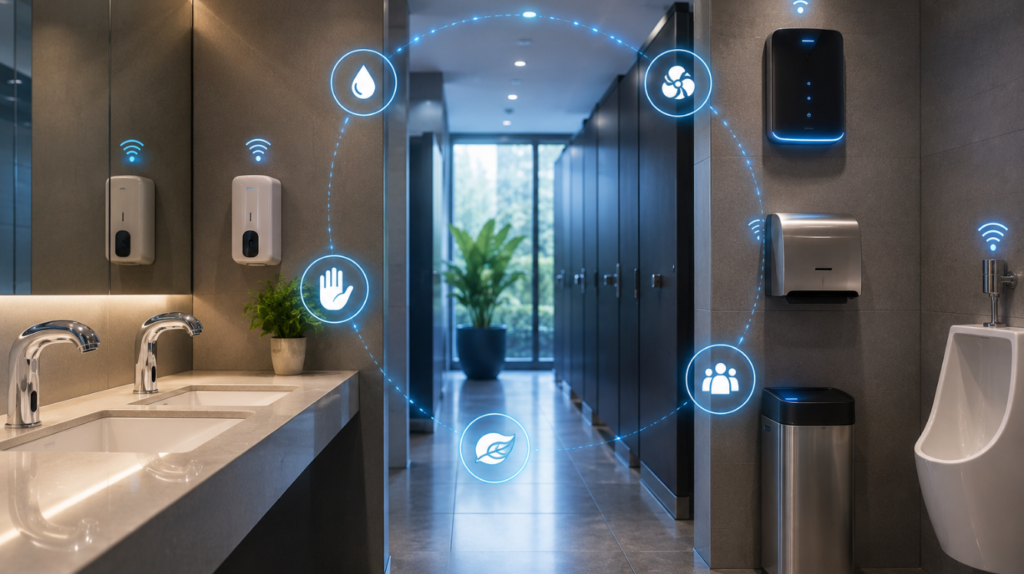
The term washroom automation refers to the employment of technology that automates the processes in a bathroom, eliminating the need for physical interaction.
As compared to manual systems, an automated system is able to recognize the presence of users in the bathroom and responds to that presence through sensors.
Water flows when the presence of hands is sensed; soap is automatically dispensed and there is no need to flush manually through the handle.
Such systems not only provide convenience but also help conserve water and energy and decrease germs.
A modern automated washroom system usually consists of the following elements:
- Sensor faucets
- Soap dispensing systems
- Flush valves operated by sensors
- Automatic hand dryers
- Automatic urinal flushing systems
- Occupancy sensors
- Intelligent lighting control
- Odor control systems
Why Commercial Spaces Are Adopting Smart Washroom Solutions
Commercial washrooms have their own set of issues that are usually difficult for traditional toilets to solve.
High visitor volume means:
- More water consumption
- More maintenance is required
- The faster deterioration of the system
- Higher hygienic risks
- Increased operational costs
Traditional fixtures rely on the correct use of fixtures by people and therefore cause significant wastage of water and inconsistency in hygiene routines.
The use of smart washroom solutions will give the managers full control over the process as well as provide a comfortable experience for all the visitors and staff members.
Components of Automated Washroom
Modern automated washroom systems make use of several technologies in order to increase efficiency.
Faucets using sensors automatically turn on the water flow whenever there are hands under the spout. Therefore, there is no need for water to run continuously and thus its consumption is reduced.
For high-volume commercial washrooms, the usage of sensor faucets increases hygiene since people do not need to touch the handles anymore.
Manual dispensers are touched multiple times per day by different visitors. Sensor dispensers distribute the controlled amount of soap each time.
The automatic flushing mechanism works right after use, thus keeping the toilet and urinals much cleaner without any effort from the user.
This not only leads to better hygiene but also provides better flushing efficiency.
Advanced dryers with sensors make it possible to do away with paper towels and minimize wastage as well as maintenance.
Many organizations prefer high-speed dryers to achieve greater efficiency as well as to cut down on costs related to supplies.
- Occupancy Sensor-Based Lighting
Lighting fixtures that come with motion sensors turn lights on upon entering and turn them off when no one is there. This is an easy way to save electricity.
The Benefits of Washroom Automation
- Enhanced Hygiene
The other major benefit of automated washroom technology is minimizing physical contact with common surfaces.
Since there is no need to touch the taps, flushing mechanism, soap dispenser, and even the light switch anymore, there is no danger of spreading pathogens.
That is why automatic restrooms are especially useful in hospitals, corporations, restaurants, and public facilities.
- Water Saving
Saving resources has become one of the top priorities of modern companies. Since sensors trigger water supply only when required, they save water from being wasted because of improper use of water fixtures by customers.
- Reduced Maintenance Costs
Standard restroom equipment sustains continuous wear because it is manually manipulated several thousand times per month.
Through reduced manual manipulation, smart bathroom facilities limit mechanical wear, which translates to fewer costs related to repairs and maintenance.
Facilities staff members will not have to address plumbing problems associated with leaks and broken handlebars.
- Improved User Experience
Customers have increasingly high expectations concerning the cleanliness and modernity of the facilities used.
Well-thought-through smart bathroom design showcases professionalism and provides greater convenience for both staff members and visitors of the facility.
Whether it is an office building, hotel, or public space, the smart restroom offers a comfortable experience for its users.
- Increased Sustainability Performance
Businesses are required to have less adverse environmental effects. Installation of automated bathroom facilities can help with achieving better sustainability through decreased water consumption, paper use, electricity consumption, and improved efficiency.
Where Smart Washroom Solutions Deliver the Greatest Value
While automation proves beneficial in nearly all commercial buildings, there are certain environments that offer a very high return on investments.
The list includes:
- Offices
- Healthcare institutions, hospitals
- Hotels, resorts
- Malls
- Airports
- Schools, colleges, universities
- Arenas, convention centers
- Restaurants
- Factories
High user flows create conditions for using automation as a tool that enhances efficiency and reduces operational expenses in the future.
How to Pick the Correct Automated Washroom Solution?
Not all commercial facilities have similar demands. While analyzing the automated washroom systems, the company must focus on such factors as:
- The number of users per day
- Water efficiency rating
- Product quality
- Serviceability
- Sensor reliability
- Power source
- Integration with the existing system of water supply
- Operating expenses
Picking high-quality products from reputable manufacturers guarantees higher performance and fewer service interventions.
In the case of commercial facilities, many architects, contractors, and facility managers prefer to use smart washrooms from companies like Nova Tech due to their advanced functionality and design.
Is Washroom Automation Worth the Investment?
The upfront cost of automation is often higher than installing traditional restroom fixtures. However, focusing only on the purchase price overlooks the long-term financial benefits.
Automated systems help reduce:
- Water bills
- Electricity consumption
- Maintenance expenses
- Cleaning requirements
- Product waste
- Plumbing repairs
At the same time, businesses benefit from improved hygiene, enhanced user satisfaction, and stronger sustainability performance.
For facilities with high daily foot traffic, the return on investment becomes increasingly attractive over the life of the building.
Final Thoughts
Modern commercial washrooms have gone beyond being functional rooms to become an integral part of the whole building experience. All the factors such as cleanliness, efficiency, sustainability, and comfort of use affect how people who visit and work there perceive the building.
The use of washroom automation allows for the creation of safer, more hygienic, and efficient washrooms with reduced operating expenses and resource consumption. Smart faucets, smart flushing systems, intelligent lights, and other washroom automation solutions can bring significant advantages to any facility.
With the development of technology, the introduction of automated washroom systems becomes not just an innovation but a necessity.
How useful was this post?
Click on a star to rate it!
Average rating 0 / 5. Vote count: 0
No votes so far! Be the first to rate this post.