
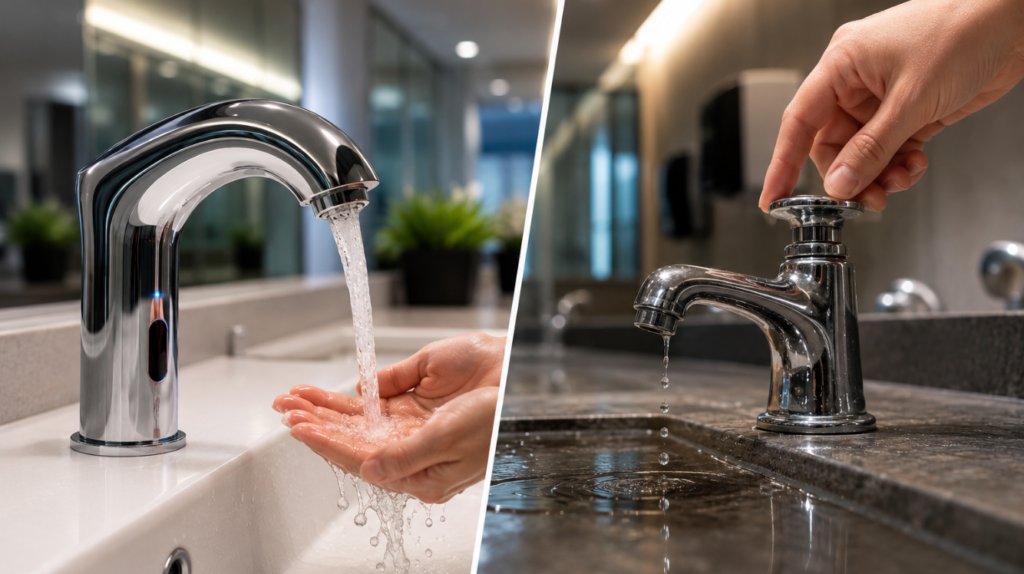
Water is one of the most precious commodities in any commercial structure, although it happens to be the most neglected at the same time. In office buildings, malls, hospitals, hotels, airports, and universities, bathrooms have a usage rate that runs into hundreds or even thousands per day.
While having a tap open for a few additional seconds might not seem much, over the course of weeks and months, this will add up to thousands of gallons of wasted water.
With companies striving to become sustainable and decrease expenses, restroom upgrades have become a viable solution.
Among various upgrades, one of the most popular solutions is the sensor tap, which is chosen as a replacement for the ordinary faucets. It is one of the many types of taps designed to improve efficiency in commercial washrooms. However, does an automatic sensor tap save more water than an ordinary tap or is it merely a technological luxury?
Here is a comparison between the two to see which of them is more efficient in a commercial environment.
Table of Contents
ToggleWhy Water Efficiency Matters in Commercial Buildings
Contrary to residential units, commercial buildings have constant human movement during the day. This is because employees, visitors, customers, and guests all use the facility.
Small inefficiencies such as keeping a faucet open for five seconds can lead to large water losses over a one-year period.
Apart from reducing water expenses, reduction in water usage will also ensure that organizations can do the following things:
- Achieve their sustainability targets
- Reduce their carbon footprint
- Enhance green building operation
- Reduce maintenance costs
- Support ESG efforts
This is why faucet selection is essential since toilets contribute greatly to total water use indoors.
How Manual Taps Contribute to Water Waste
The usage of manual taps has always been popular for many decades; however, they totally depend on people’s actions.
People have to switch on the water first, wash hands and switch it off at last. This kind of approach results in additional wasting water in commercial places.
The main issues include the following:
the additional wasting of
- The water flow never stops while using soap.
- The faucets are never completely turned off by people.
- Deteriorated handles of the faucet result in continuous dripping.
- People switch on the tap and keep it working for different periods of time.
It might seem to be a tiny issue for each person; nevertheless, considering hundreds of users, the problem becomes really important.
How Does a Sensor Tap Work?
A sensor tap is based on infrared sensors and operates according to the movement of the hands under the tap. The water starts flowing when the hands are detected and automatically stops when the motion is over.
Whether installed in office washrooms, healthcare facilities, airports, or hotels, a sensor water tap provides consistent water flow while minimizing unnecessary usage.
Sensor Taps vs Manual Taps: A Side-by-Side Comparison
| Feature | Manual Tap | Sensor Tap |
| Water control | Depend on the user | Fully automatic |
| Hygience | Users touch handles | Completely touch-free |
| Leak risk | Higher due to mechanical wear | lower |
| User experience | Conventional | Modern and convenient |
| Maintenance | Frequent repairs over time | Reduce wear and tear |
While both types of faucets perform the same basic function, the way they manage water usage is fundamentally different
Four Ways Sensor Taps Save More Water
- Water Turns Off Instantly
Another important feature of the automatic sensor tap is its auto shut-off feature.
Faucets usually keep dripping when users reach out for soap or a hand dryer. Sensor faucet solves this problem by automatically shutting off once your hands get away from the faucet.
After thousands of uses, this small difference in time adds up and results in big water savings.
- All Users Use Same Amount of Water
Manual faucets require different water-use habits of each user. Some of them may leave it running for too long; others might not turn it off at all.
The touchless faucet provides an equal amount of water to every person who uses it. This makes the process of water usage much more predictable.
- No Water Leakage Due to Wear-and-tear
Commercial restroom faucets undergo thousands of uses daily. Each time they are turned on and off, some parts start wearing out. In the end, it leads to leakage.
The fact that no one touches the operating mechanism of the sensor water tap minimizes wear and tear.
- Encourages Sustainable Behavior
Often, technology affects one’s habits.
Using a touchless faucet, for instance, will make people use only that amount of water that is necessary for hand washing. People will not be encouraged to leave the faucet running.
This way, technology will help the company implement sustainability efforts without changing people’s behavior.
More than Water Efficiency
In addition to saving water, there are other reasons why commercial facilities prefer sensor-operated faucets.
First, it is obvious that touchless design decreases the possibility of spreading germs. For even better hand hygiene, many facilities also install an automatic soap dispenser alongside sensor taps.
Thus, a sensor tap for a wash basin is one of the bathroom accessories that can significantly improve hygiene and convenience in commercial spaces.
It will be useful in:
- hospitals
- hotels
- restaurants
- schools
- airports
- corporate offices
- shopping malls
The lack of contact between hands and the faucet will improve the level of hygiene in restrooms.
Is It Worth Buying an Automatic Faucet at All?
A regular faucet costs less but in terms of the total cost of ownership, things look different.
Commercial facilities should take into consideration:
- water bill
- repairing costs
- maintenance labor costs
- cost of replacement parts
- water losses due to leaks
In the long term, it may pay off because of water savings and low maintenance costs. The savings that can accrue from using the sensor tap will be huge if the building has lots of people moving around on a daily basis.
Selecting the Best Sensor Tap for Commercial Buildings
All types of taps have their unique uses. In the selection of a **sensor tap for a wash basin**, you need:
- Taps made from durable materials like brass or stainless steel
- Quick and responsive infrared sensors
- Water-saving capability without any reduction in efficiency
- Choice of power sources
- Maintenance accessibility
- Longevity
Such products made by reputable brands like Nova Tech are made to operate efficiently within such environments and save on water usage.
To wrap up
In this case, it is quite easy to determine which option would work better.
The sensor tap will always be more efficient in conserving water compared to the manual faucet, as it eliminates the most important factor responsible for the wastage, i.e., human error. This is because the sensor faucet controls water flow, reduces leakage and guarantees that every user uses only what they require.
For commercial establishments that want to be more sustainable, lower their utility bills, and maintain a cleaner and more modern washroom, installing an automatic sensor tap is a good move in the long run.
Related Articles
How Air Curtains Work And Why They’Re Worth Installing
10 Advantages Of Diaper Changing Station in Public Bathrooms
Top 10 Modern Bathroom Water Tap Designs for 2025
Wall-Mounted vs Free-Standing Tissue Dispensers: What to Consider?
How useful was this post?
Click on a star to rate it!
Average rating 0 / 5. Vote count: 0
No votes so far! Be the first to rate this post.