
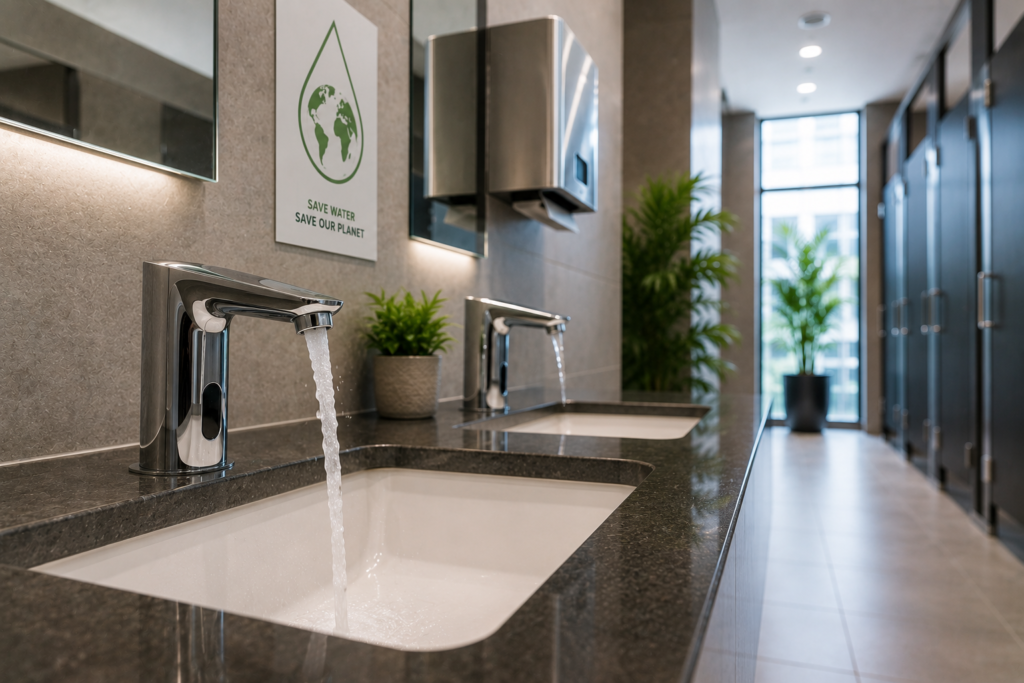
Water conservation has now emerged as a vital objective for various commercial establishments. Office complexes, airports, shopping malls, hospitals, hotels, schools, universities, and other institutions use thousands of gallons of water each year, out of which the restrooms alone contribute a huge amount of consumption.
To keep a check on the rising cost of utilities and to achieve sustainability goals, businesses are increasingly resorting to using the sensor faucet, a great innovation that has come to their rescue.
Instead of using the old-fashioned tap that keeps pouring water till it is switched off by the users, the **touchless faucet** provides only the required amount of water and stops the water flow once the hands move away from the sensor area.
With time, commercial buildings are increasingly integrating advanced technology in their operation, and the automatic faucet has started to emerge as a common fixture in washroom designs.
Table of Contents
ToggleThe Problem with Traditional Faucets
In what ways do traditional faucets create water wastage? In most cases, people leave the faucet on while they are washing their hands, putting on soap, or drying their hands. Sometimes, in a busy place like an airport, mall, or office, people leave the faucet on because it is not properly turned off, and this creates water wastage throughout the day.
In places with a lot of foot traffic, like airports, malls, and offices, even a second or two of water wastage per use translates to thousands of gallons of water wastage every year.
Building owners understand that saving water through this method requires much more than just educating people about responsible usage; the answer is in technology.
How Does a Sensor Faucet Work?
The **sensor faucet** works through infrared, which can sense any movement of hands under the spout. In case movement is sensed by the sensor, an electric valve opens up and allows water to flow. As soon as the user moves away from the faucet, the valve closes down and stops water flow.
Since the water only flows when needed, there is no chance that anyone leaves the taps flowing unnecessarily. That is how an automatic water-saving faucet is highly effective in commercial places.
Modern designs have been developed to function well in high-traffic buildings in which several hundred or thousand people use the washrooms on a daily basis. Some versions even have flow restrictors or timers added to them.
Eliminating Unnecessary Water Flow
One of the major benefits of using a touchless faucet lies in the ability to prevent waste water usage while washing hands.
When using manual taps, people usually switch on the tap before applying the soap and keep the water flowing throughout the whole process. Researchers have found that a large amount of water is wasted at idle times.
On the contrary, an automatic faucet starts water flow when there are hands below the spout and switches off when the hands are moved from the spout in order to use soap or dry them. Consumption of water can be reduced without changing the behavior of the user.
These small changes add up to significant savings when thousands of visitors use the restroom each day.
Preventing Leaks and Dripping Faucets
Leaky faucets are among the major sources of water wastage in commercial establishments. While the dripping may seem small, after several weeks and months, it can end up causing the wastage of thousands of gallons of water.
The sensor tap does away with all the mechanical problems caused by conventional taps whose handles and cartridges have been worn out because of being manually handled constantly. The user does not handle the tap at all and therefore does not cause any strain on the parts.
Reducing Water Consumption During Peak Usage
Commercial facilities tend to have times when there is an exceptionally high demand for the usage of restrooms.
At those high-demand times, manual faucets tend to be left running for longer than needed due to user behavior and other distractions. Installing a commercial faucet with sensor technology will ensure that each and every time people wash their hands, just enough water gets used.
Consistent control of water usage allows facility managers to estimate water usage and minimize unnecessary usage when it comes to high-demand times.
Overall, it may lead to considerable savings for commercial property owners in terms of utilities costs per month.
Contributing to Sustainable Goals
Modern organizations aim to obtain various sustainability certifications and meet the objectives regarding resource efficiency.
Installing a water-saving faucet allows them to reach that goal because they get to save water without affecting user experience.
Water conservation leads to:
- Savings on utilities costs
- Improved environmental performance
- Facilitating the green building initiative
- Decreasing pressure on the local water supply
It may also help to earn some points towards LEED certification.
Improving Hygiene in Commercial Restrooms
While water savings have been one of the driving factors of its adoption, hygiene has become an equally important consideration in the decision to install a touchless faucet.
Standard faucets require people to touch the handle before and after washing their hands, thereby allowing germs to pass from one user to another.
With a sensor faucet, this problem no longer exists. People can wash their hands without ever touching the faucet and enjoy a more hygienic bathroom experience.
This feature is particularly important in such places as hospitals, healthcare centers, schools, airports, and restaurants.
Reduced Maintenance Costs
The third hidden cost of manual faucets is maintenance expenses.
Manual faucets have moving parts, including a handle, cartridge, and seal, that eventually wear out due to the physical usage of the faucet.
The increased frequency of repair and replacement of faulty components leads to increased maintenance costs.
An automatic faucet not only reduces physical stress but also increases the lifespan of the device. Moreover, many contemporary automatic faucets have diagnostic lights, which make maintenance more convenient.
Creating a Modern User Experience
Modern users demand smarter and hands-free interactions in public places. Touch-free technologies are becoming more and more popular in airports, hotels, office buildings, and shopping centers.
The installation of a modern commercial faucet can contribute to creating a more premium and high-tech atmosphere in the restroom.
Users tend to associate the touchless fixtures with hygiene, innovation, and high-quality facility management. In highly competitive industries like hospitality or commercial real estate, these factors may make an impact on how a building is perceived.
Where Sensor Faucets Will Provide the Maximum Benefit
While virtually any facility can save money by installing the sensor faucet, certain facilities tend to be the most profitable in terms of ROI.
The examples of the commercial buildings, in which the installation of the sensor faucet helps to save some money, are office buildings, hospitals, hotels, airports, educational institutions, shopping malls, sports arenas, restaurants, and entertainment venues.
At the facilities, which are visited daily by hundreds or even thousands of visitors, any actions aimed at water savings can bring good results.
Smart Water Conservation with Nova Tech
As organizations are constantly improving their sustainability and hygiene, the manufacturers create more and more sophisticated products for commercial washrooms.
Nova Tech provides customers with a variety of smart restroom products suitable for high-traffic commercial facilities. These include advanced sensor faucets, sensor tap and other touchless solutions allowing businesses to reduce water usage and improve hygiene.
Final Thoughts
Water savings are not only an environmentally friendly approach; now it also becomes an operational technique that can help save money and increase efficiency.
Installation of the smart sensor faucet* provides one of the easiest and most efficient ways to reach this aim. As it helps to save the unnecessary use of water, to prevent leaks, to improve hygienic conditions, and to decrease maintenance efforts, the hands-free faucet proves its efficiency.
With the increasing use of smart building technology in commercial buildings, the use of the automatic faucet and other touch-free options will probably increase even more.
How useful was this post?
Click on a star to rate it!
Average rating 0 / 5. Vote count: 0
No votes so far! Be the first to rate this post.