
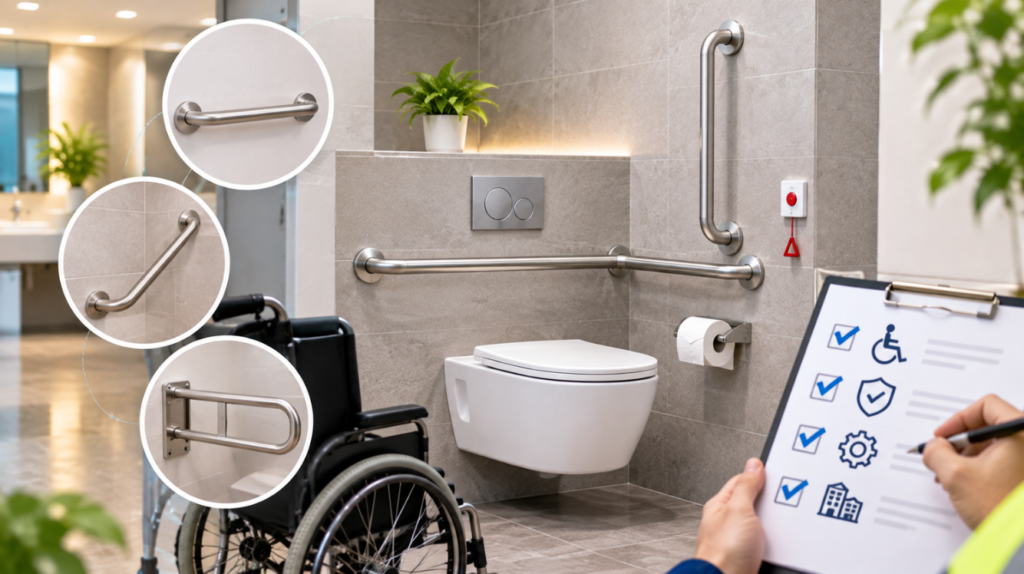
Now imagine that the guest at your facility’s washroom finds it hard to sit down, stand up or keep balance near the toilet. And this simple task becomes really challenging because of the lack of proper supports. This is where grab bars are needed.
From the manager’s side, making the washroom accessible is not just about buying a few railings. They need to be durable, well-mounted, easily graspable and appropriate to the users. They need to correspond to the accessibility requirements.
Whatever kind of facility you operate; hospital, hotel, office building, shopping centre or any educational establishment, knowing what to choose will be helpful in making practical decisions on procurement. Here is what should be taken into consideration while choosing the grab bars for your facility, taking into account Nova Tech products.
Table of Contents
ToggleWhy Are Grab Bars Important in Accessible Washrooms?
Washrooms may have slippery floors, and sitting, standing, and moving from a wheelchair need balance and stability. If no proper assistance is available, such actions will cause falls.
Handicap bathroom grab bars offer support to users that helps them keep their balance and feel confident while using the toilet and other fixtures. Grab bars can promote the independence of seniors, disabled people, and injured people.
If there is an influx of visitors during the daytime hours, then accessibility should be considered a practical issue. The right choice of grab bars can facilitate access to a better life.
However, not all grab bars are equally applicable to any situation. The shape, size, installation process, and place of installation should coincide with the needs of the washroom.
- Understand Accessibility Standards Before Buying
Before selecting any products, facility managers need to determine the applicable accessibility standards for their facilities.
For example, in the US, the Americans with Disabilities Act (ADA) Standards for Accessible Design defines accessibility guidelines for grab bars in accessible toilet rooms, among other requirements.
When examining grab bars ADA bathroom requirements, it is important to take into account the following requirements:
- Grip dimensions: Circular grab bars normally need to have a 1¼ – 2 inch diameter based on ADA Standards.
- Clearance from the wall: Normal clearance from the gripping surface and other adjacent surfaces is 1½ inches.
- Load bearing: The bars need to be able to hold specified loads.
- Positioning: The bars are needed to be installed based on specified criteria for the particular fixtures and accessible arrangement.
Based on the 2010 ADA Standards, grab bars and their supporting components have to be resistant to a 250-pound (1,112 N) load applied at any point of the bar.
It is important to note that the purchase of an accessible product does not automatically mean installation compliance with the guidelines. Facility managers in India have to consider applicable accessibility standards in their country when setting up an accessible toilet
.
- Select the Right Type of Grab Bar
The varying designs of washrooms also determine which support system should be used. Identifying this first involves identifying areas where the users will require support and how they will move within the space.
- Straight Grab Bars
Straight grab bars are usually found beside toilets and in walls where users require a secure handrail for stability. They are made available in varying lengths to fit the particular washroom design requirements.
- Angled Grab Bars
Angled bars allow users to hold on to the support at varying levels and from different angles.
- Fold Down Grip Bars
Fold down grip bars may be a good option in specific accessible toilet configurations where extra space is required during times when the gripping bar is not being used.
- Wall-Mounted Support Rails
Fixed rails create a stable gripping surface for their intended use. In selecting handicapped bathroom rails, the space available, how they are to be fixed, and the type of movement supported need to be considered.
It will depend on the needs of the users, the layout of the building, and the relevant accessibility regulations, rather than just aesthetics.
- Choose Durable Materials and Suitable Finishes
Commercial washrooms see heavy usage and are often wet and cleaned frequently, much like other commercial bathroom fixtures
. Thus, the material used in the grab bar plays an important part in its durability.
The following aspects have to be taken into account when considering grab bars for accessible bathrooms:
- Material: The most popular one is stainless steel.
- Finish: Make sure the finish provides a comfortable and easy-to-clean surface.
- Resistance to corrosion: Verify if the material is appropriate for the wetness level and the cleaning agents in the washroom.
- Construction: Analyze the entire grab bar system including bar itself, mounting hardware, etc.
Using durable grab bars would save money on the replacement and maintenance work. Nevertheless, it is always necessary to choose the materials that suit the installation site best.
- Prioritise Grip, Dimensions, and Clearance
It is vital that a grab rail be easy to grip and use. This applies especially to individuals who have weaker grips, poor dexterity, or balance issues.
In selecting handicap bathroom handles, consider the diameter of the gripping surface, shape, clearance from the wall, and location of the installed grip.
Under ADA Standards, circular gripping surfaces with a diameter of 1¼ or 2 inches are acceptable. Some non-circular designs are also acceptable if they meet all the relevant dimensions and clearance standards.
Also, facility managers should look at the fixtures in the environment. Dispensers, toilet paper holders, shelves, and other fixture components should not encroach on the required gripping area.
Products should not be selected simply on the basis of aesthetics or the claims of accessibility made by suppliers. Technical specifications should be considered before approval of purchase.
- Plan Placement Around User Needs
An otherwise good quality grab bar may not be of much help if placed incorrectly. The facility manager should think about how the user accesses the toilet, transfers from the wheelchair, sits down, and stands up.
Following best practices for designing handicapped toilets ensures the position of grab bars matches the requirements and the particular type of fixture and washroom.
The installation of accessible toilets often includes grab bars placed behind the toilet and one adjacent side wall. Specific positioning will depend on standards, toilet size, and wall configuration.
Before the installation, assess the manoeuvring space, required clearance, fixture location, and wall structure. Make sure that the future users are able to reach and use the bars easily.
A site inspection by the architect, contractor, and accessibility consultant—guided by commercial restroom design standards can prevent difficulties during the installation process.
- Verify Mounting Strength and Installation Quality
The effectiveness of the grab rail does not only depend on its materials but also on how it is mounted and the type of wall it will be installed in.
When evaluating handrails in ADA-compliant bathrooms, it is important to consider the installation instructions and load criteria provided by the manufacturer.
It is necessary to determine what type of brackets, fasteners, and structural elements are needed according to the specification.
Moreover, the installation process must be done in accordance with all requirements, especially regarding the wall substrates and manufacturer’s instructions.
It is wrong to think that just because the grab rail is made of stainless steel, it will always be safe when mounted on the wrong wall. One must not experiment with the load of the installed grab bar either.
Installation requirements and guidelines will assist in providing a satisfactory finished product.
- Include Maintenance in Your Procurement Plan
When considering the lifespan of a grab bar, facility managers need to think beyond its cost at purchase time. Routine maintenance will allow detecting any potential issues prior to jeopardizing users’ safety.
An efficient inspection program needs to include checks for loose connections, corrosion, wear, movement, and degradation near mounting areas. Cleaning supplies should be chosen according to compatibility with the materials.
In the case of high-usage facilities, regular inspection intervals are to depend on usage statistics, manufacturer recommendations, and maintenance requirements. Fittings which show signs of damage and instability are to be inspected immediately and decommissioned if necessary.
Choosing sturdy bathroom bars for handicapped people and planning regular maintenance makes it possible to reduce long-term maintenance costs and ensure reliable functioning of accessible bathrooms.
How Nova Tech Fits into Accessible Washroom Planning
The selection of washroom fixtures that are easily accessible involves collaboration among facility management, architects, contractors, and procurement departments. Each fixture has to integrate with the facility structure and fit the users’ needs.
Nova Tech is one of the options you should consider during the product evaluation process for accessible washrooms. Prior to buying the product, take into account the product range, dimensions, material, mounting specifications, and technical information provided.
In case you need to purchase handicap bathroom grab bars alongside smart washroom automation solutions, emphasize the durability, usability, mounting, and standard compliance of the selected product. A well-thought-out specification allows comparing products without the influence of price and design considerations alone.
A well-thought-out specification allows comparing products without the influence of price and design considerations.
Conclusion
Design of accessible washrooms requires careful selection of products and proper installation. From material selection to grip size, installation strength, and location – all of these elements play an important role in providing a safe and accessible facility.
When evaluating the design of accessible bathroom grab bars, facility managers need to review the entire washroom design plan, find out accessibility specifications and make sure there is a maintenance plan before ordering the products.
With proper planning and product evaluation, you can reach out to Nova Tech to find the right solution for designing accessible washrooms.
Frequently Asked Questions
- How do grab bars work in accessible washrooms?
The grab bars work as sturdy hand supports which assist individuals with limited mobility while balancing, sitting down, standing up, and maneuvering the washroom fixtures.
- What is the standard diameter of grab bars according to the ADA?
According to ADA standards, grab bars with a circular design need to have a diameter ranging from 1¼ to 2 inches.
- Which material can be used for grab bars in accessible bathrooms?
Stainless steel is often recommended due to its durability and corrosion resistance properties. It all depends on the environment and maintenance needs.
- Where should grab bars be placed close to the accessible toilet?
In the most common accessible toilets, two grab bars need to be installed on the rear and side walls.
- How can facility managers take care of grab bars?
It is important to inspect the grab bars regularly for any loose joints, signs of corrosion or damage and instability.
How useful was this post?
Click on a star to rate it!
Average rating 0 / 5. Vote count: 0
No votes so far! Be the first to rate this post.