
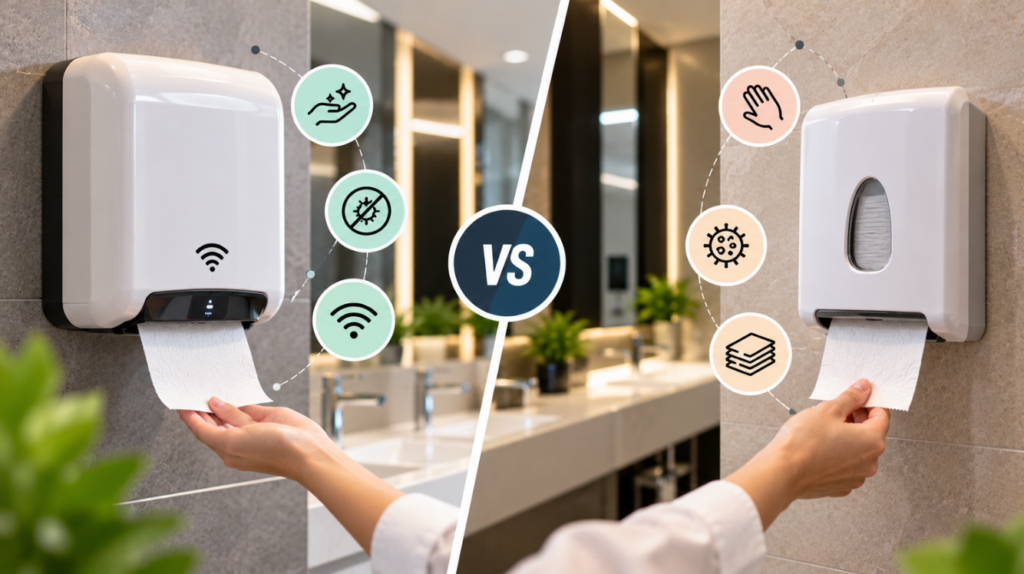
Washrooms in commercial buildings require balancing hygiene, efficiency, maintenance, and costs. Even though toilet tissue might appear as an insignificant component of washroom infrastructure, the choice of its dispensers is important since it can affect the overall efficiency of a washroom.
The choice between manual and sensor-based dispensers is up to companies according to their needs.
The tissue dispenser with sensor is a dispenser that detects user actions and dispenses tissue with little physical contact from users. As opposed to manual dispensers, users must pull, press, or tear off tissues themselves. Both dispensers have their pros and cons, and selection depends on a variety of criteria, including foot traffic, hygiene, maintenance, and cost.
For office buildings, hotels, restaurants, hospitals, shopping malls, airports, and other commercial buildings, it is useful to know the difference between these two types of dispensers.
Table of Contents
ToggleWhat Is a Sensor Tissue Dispenser?
Sensor tissue dispenser refers to a contemporary dispensing system that operates on the principle of sensors detecting the presence of the hand of the user or any other movement. When the sensor detects the user, it dispenses an allotted quantity of tissue.
Since the user need not necessarily come into contact with the dispenser, this is ideal for use in commercial settings where there are many users using the washrooms during the course of the day.
The sensor dispenser comes in different designs according to the type of tissue that will be used, which could be folded tissues, continuous paper, and tissue rolls.
What Is a Manual Tissue Dispenser?
A manual tissue paper dispenser will need physical intervention in order for the paper to be dispensed. The person may need to depress a lever, push a button, pull the tissue, or manually rip off the desired quantity of paper.
Manual dispensers have found use in commercial restroom settings since they are fairly easy to use and maintain. They normally lack batteries and electronic parts, thus making them easier to maintain.
The manual dispenser is ideal for offices, small businesses, restaurants, and schools, among others that do not necessarily require an automated version.
Sensor vs. Manual Tissue Dispensers: Key Differences
Both dispensing devices have one and the same purpose, yet the way they work and are maintained can differ significantly.
- Hygiene and Physical Touch
Perhaps, one of the most significant differences lies in how much touch they involve.
The sensor device will automatically dispense paper when a person puts his/her hand near the device, which means that no touch will be involved. This characteristic may be especially convenient when the facility has many people and everyone touches the same fixtures.
A manual device will obviously involve some physical touch, although keeping the dispenser clean and conducting the necessary maintenance can make it hygienic enough. It depends on whether there is a need to minimize the contact with a facility.
- User-Friendliness
A sensor device will offer a fairly easy way of use. The person needs to put a hand close to the sensor, wait until paper comes out, and take it from there.
A manual device does not require any specific effort; a person needs to use the device mechanically. Nevertheless, since manual devices are used everywhere, users already know how to operate them.
- Tissue Consumption
Controlled dispensing can help institutions to regulate the amount of tissues consumed. A sensor dispenser can be built such that it will dispense a specified amount every time it is used, thus limiting any excess pulling.
But this is dependent on the dispenser setting, the quality of the tissues, individual user behavior, and frequency of use.
The manual tissue roll dispenser allows for individuals to regulate their use of paper. Though this may be beneficial, it may lead to increased consumption as users may pull more paper than required.
- Maintenance Issues
Manual dispensers usually do not have many parts that will require technical skills. If the dispenser is well-made, maintenance should just involve cleaning and replenishment of tissues.
Sensor dispensers will have electronic parts, and they will need to be powered. The staff should keep track of the power requirements and ensure the functionality of the sensor and dispensing mechanism.
This is not necessarily hard to do, but the process is different from manual dispenser maintenance.
- Operating Costs
The starting price is not the whole story. The company should also factor in tissue consumption, parts and battery replacements, service, and durability.
The manual dispenser can be cheaper in terms of both the upfront and maintenance costs because of its simplicity. The sensing mechanism may have higher initial costs, but controlled dispensing will allow managing the tissue consumption.
The exact numbers depend on the specific product, the tissue, the usage level, and the maintenance of the facility.
What Is a Tissue Roll Dispenser?
The tissue roll dispenser is a mechanism to store and distribute tissue from the roll. It can be either manual or automatic depending on the dispensing method.
Tissue roll dispensers are popular in commercial washrooms since they are capable of storing quite a lot of tissue and thus require infrequent refills.
When selecting the roll-based dispenser, it is important to pay attention to the roll size, dispenser capacity, type of paper, and how easy it is to change an empty roll.
In facilities that have high foot traffic, a bigger-capacity tissue paper roll dispenser will help to cut down the number of times that cleaning staff needs to refill it.
When Should You Choose a Sensor Dispenser?
The sensor dispenser may be suitable for commercial facilities that have a need for non-contact operation and convenience.
Think about using sensors if:
- There is heavy usage of the washroom on a daily basis
- The facility has an emphasis on minimizing contact with shared surfaces.
- There are different people who will use it through the course of the day.
- There is a need for regulated tissue dispensation.
- Maintenance staff who will check batteries and equipment is available.
Some examples of facilities that may consider using a sensor dispenser system include hotels, airports, hospitals, shopping centers, office buildings, and restaurants.
When Is a Manual Dispenser a Better Fit?
A manual dispenser could be an ideal choice if the main concerns are simplicity, cost-effectiveness, and maintenance.
A manual dispenser might work well in:
- Small and mid-sized offices
- Washrooms with low to moderate traffic flow
- Restaurants and other small commercial locations
- Schools and other institutions
- Places that do not have many maintenance resources
- Places where a business wants a simple dispensing solution
Lack of electronics could also simplify the troubleshooting and maintenance process for manual dispensers.
Selecting a Commercial Washroom Dispenser: Factors You Should Consider
When making the selection, a business shouldn’t base its decision only on whether the dispenser is manual or automatic but should look at the entire washroom environment.
- Measure Washroom Traffic Flow
The first thing to do is calculate how many people use the washroom per day. A place with a large number of daily visitors would benefit from high-capacity and controlled dispensing systems.
In a small office, a basic manual dispenser could suffice.
- Consider Your Hygiene Requirements
If touch point reduction plays a key role in your facility’s hygiene practices, you may consider using a sensor-activated dispenser.
Nevertheless, automation does not mean neglecting cleaning procedures. The dispenser, surfaces around it, and restroom accessories need to undergo proper maintenance procedures on a regular basis.
- Compatibility Check for Tissues
Ensure that the dispenser will be compatible with the type and size of the tissue utilized in your facility. A tissue paper roll dispenser, intended for one particular roll size, may prove to be incompatible with another kind of tissue.
Checking for compatibility will help avoid issues with dispensation.
- Consider Capacity
The use of larger dispensers will decrease the number of times that you will need to refill them. This is particularly helpful where there is high traffic in the washrooms.
It is important to note that, although it is useful to use a larger dispenser, this does not mean you should buy the largest dispenser available. Select a capacity of dispenser depending on the use.
- Consider Maintenance
Consider who will be responsible for the cleaning, maintenance, and refilling of the dispenser. In case you are using the electronic systems, you will need to factor in the battery changes.
Why Choose Nova Tech for Commercial Washroom Solutions?
The washroom facilities need machines that are functional and durable in nature as well as easy to maintain. Nova Tech offers solutions for washrooms that cater to the demands of the modern commercial environment.
Whether a firm is opting for an automatic paper dispenser system, which is required in case of heavy traffic areas, or a regular manual dispenser, the choice needs to be made keeping in mind the usage, cleanliness factor, tissue demand, and ability to maintain.
The solution offered by Nova Tech is practical in nature, which helps businesses create an organized and professional washroom space.
Final Thoughts
The selection of a dispenser that is appropriate between a sensor tissue dispenser and a manual tissue dispenser will be determined by the needs of the commercial washroom.
A sensor tissue dispenser may be able to offer touch-free, controlled dispensing and a sophisticated user experience. On the other hand, a manual tissue dispenser may be able to give ease of operation, be easy to maintain, and be low cost.
Neither the automatic tissue dispenser nor the manual tissue dispenser is good for all facilities. Organizations have to look at the daily foot traffic, hygiene, tissue usage, dispenser capacity, maintenance needs, and budget before choosing a dispenser.
Where reduced touch and controlled dispensing are desired in a high-traffic commercial facility, then the organization might consider an automatic toilet paper dispenser or any other sensor tissue dispenser. If it is a small or low foot traffic facility, the organization may choose a manual dispenser that is effective.
This ensures the creation of easy-to-manage washrooms. Nova Tech has solutions to help in meeting these commercial washroom needs.
How useful was this post?
Click on a star to rate it!
Average rating 0 / 5. Vote count: 0
No votes so far! Be the first to rate this post.