
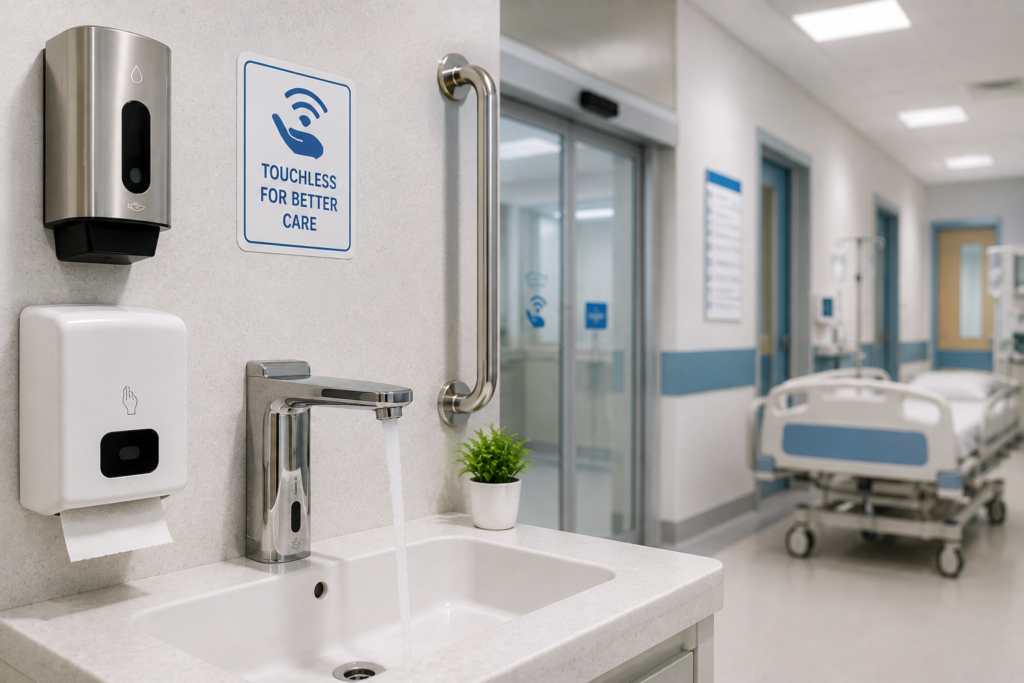
For many years, healthcare facilities have been facing a problem of ensuring the best hygiene standards despite providing services to many patients, visitors, and health care specialists on a daily basis.
Nowadays, though, the necessity to minimize physical interaction with common areas has gained even greater significance, and hence hospitals and medical facilities all over the United States are beginning to adopt touchless technology in order to promote cleanliness, ensure the safety of their clients and increase operational efficiency.
It is becoming increasingly popular to see such innovations as automatic faucets and soap dispensers, sensor-activated doors, and other examples of touch-free technology being used in modern healthcare facilities.
Table of Contents
ToggleThe Growing Need for Better Infection Prevention
In the hospital environment, stopping the transmission of bacteria and viruses is always on the agenda. Each day sees many individuals come into contact with touchpoints like door handles, taps, flushes, soap dispensers, elevator buttons, and hand dryers.
Despite the cleaning of these touchpoints being routine and even if there are disinfections, they can still play a part in the transmission of pathogens among patients, staff, and visitors. Enhancing the quality of hospital hygiene cannot only be achieved through increasing the frequency of cleaning.
This is one of the main reasons why healthcare establishments are increasingly turning towards touchless solutions.
How Touchless Technology Reduces Surface Contact
The traditional fixture and the building systems usually have several touch points per each visit. A user may need to use the door handle, faucet handle, soap dispenser, flush valve, and paper towel dispenser in order to leave the bathroom.
Through implementing touchless technology, hospitals will be able to cut down on a lot of those actions. Thanks to sensors, people will be able to use the facilities such as the handwashing station and the toilet without having any contact with any surfaces.
Such an approach will facilitate implementation of infection control measures at a hospital.
Sensor Faucets Are Becoming Standard in Hospitals
One of the most popular applications of touch-free technology in health care settings is the sensor faucet.
Unlike regular faucets, which require manual turning on and off by using handles, sensor faucets turn on and off automatically when hands are put under the spout.
There are several benefits of this innovation: it decreases the number of contacts, saves water and promotes hand hygiene among patients, visitors and medical staff.
As hospitals are renovating their infrastructure, sensor-operated devices become an integral part of modern hospitals.
Automatic Soap Dispensers Increase Compliance with Hand Hygiene Protocols
Hand hygiene still continues to be one of the most efficient measures to prevent hospital infections.
Automatic soap dispensers make the hand hygiene process more convenient, eliminate the necessity of touching contaminated handles and promote compliance with protocols.
Since automatic dispensers distribute the exact amount of liquid soap per use, they can significantly save costs and decrease waste generation.
In a busy environment where there are hundreds of handwashes daily, such systems are an important part of the hospital hygiene strategy.
Touchless Flush Systems Support Cleaner Restrooms
Among the most used areas in any health institution are restrooms, which require high levels of hygiene.
Touch-free flush systems eliminate the need for touching the flush handle, providing a proper cleaning of the fixtures after each use. Not only do they increase the convenience factor but also help enhance infection control.
Touchless flush systems, together with sensor faucets and automatic soap dispensers, make the restroom more hygienic for patients, visitors, and personnel.
Smart Washrooms Change the Face of Healthcare Institutions
The modern smart washroom not only consists of the individual touchless fixtures but also Modern health institutions often have integrated technologies that enhance maintenance efficiency and manage the hygiene process better.
It includes occupancy tracking, soap level alerts, leak detectors, and maintenance notifications, allowing quick solutions for possible problems.
With the help of such technologies, the facility manager ensures availability of supplies and efficient work of the equipment even at times of peak load.
The development of the healthcare sector into the digital one is likely to lead to the expansion of the smart washroom application.
Reducing Water and Energy Consumption
While enhancing hygiene is the main priority, many hospitals have discovered the additional environmental and economic advantages of **touchless technology**.
The sensor faucets dispense water when it is needed, thus decreasing its unnecessary wastage. The automatic lighting systems decrease energy consumption through turning the lights off when rooms are vacant. Dispensing systems control the usage of soap and paper products.
Small efficiency gains mean significant cost savings for large hospitals working 24/7.
The sustainability features of **touch-free technology** make it a great choice for healthcare managers who aim to cut down costs and achieve sustainability goals at the same time.
## Enhancing the Patient Experience
Patient experience is becoming more and more significant in modern medicine.
Many visitors perceive touchless installations as a symbol of hygiene, innovation, and quality of the services provided by a hospital. When entering a bathroom equipped with new sensor-operated systems, they receive assurance regarding the facility’s commitment to hygiene.
Patients suffering from various diseases, including those related to the weakened immune system, can feel more comfortable when touching fewer surfaces.
In other words, investments into **touchless devices** increase not only efficiency but also patient satisfaction.
Supporting Healthcare Staff
Doctors and nurses typically spend many hours walking around from one room to another and performing various treatments. Therefore, limiting the number of surfaces they have to touch daily will be effective at reducing contamination and increasing efficiency.
Touch-free doors, sensors on faucets, and dispensers make healthcare employees perform their activities faster and easier in accordance with hygienic standards.
Considering the growing focus of hospitals on their employees’ well-being and safety, touch-free solutions are becoming an essential part of healthcare workplace design.
## Future Directions of Touchless Healthcare Technologies
The future of touchless systems in the field of medicine is promising, as there is going to be a great development in this area in the coming years.
New technologies are going to include voice-control systems, mobile access technologies, occupancy monitoring systems that are powered by AI, and even systems for predicting equipment malfunctions.
All these technologies will make the infection control measures stronger and increase the operational performance.
Thus, hospitals that incorporate new technologies into their operations will become leaders in the next stage of the healthcare industry.
Supporting Healthcare Facilities with Smart Solutions
The need for creating a more hygienic and efficient health care environment is prompting rapid innovations in restroom and hygiene technologies.
Nova Tech offers sensor-based solutions that help create better conditions in the modern health care facility by installing automatic faucets, touchless flushing mechanisms, soap dispensers and other technologies that help achieve better levels of hospital hygiene and operational efficiency.
Final Thoughts
Adaptation of touchless technology is not just a way to respond to changes in the expectations anymore; it is a key strategy for creating a more hygienic, safe and efficient environment.
With the help of such tools as sensor faucets, automatic dispensers and smart washrooms, the healthcare facilities can reduce contacts with the surfaces and improve infection control measures.
Adaptation of the touch free technology and touchless devices in the health care facilities will only gain relevance when the institutions continue modernizing their facilities.
How useful was this post?
Click on a star to rate it!
Average rating 0 / 5. Vote count: 0
No votes so far! Be the first to rate this post.